The 1550 Manuscript
The autograph chronicle of Simone del Pozzo: a direct journey to the 16th century.
📋 Primary Source
Title: "Libro d'Estimo generale della città di Vigevano e suo territorio con cronache e notizie stor. ed elenco delle materie in esso contenute 1550. Italia"
Author: Dal Pozzo, Simone (Chancellor of Vigevano).
Source: Archivio Storico Comunale de Vigevano.
This exceptional document is not just a tax census; it is a family and political chronicle written by an eyewitness. Below, we present the full transcription of the most relevant folios, organized thematically.
Chapter I: Origin and Identity
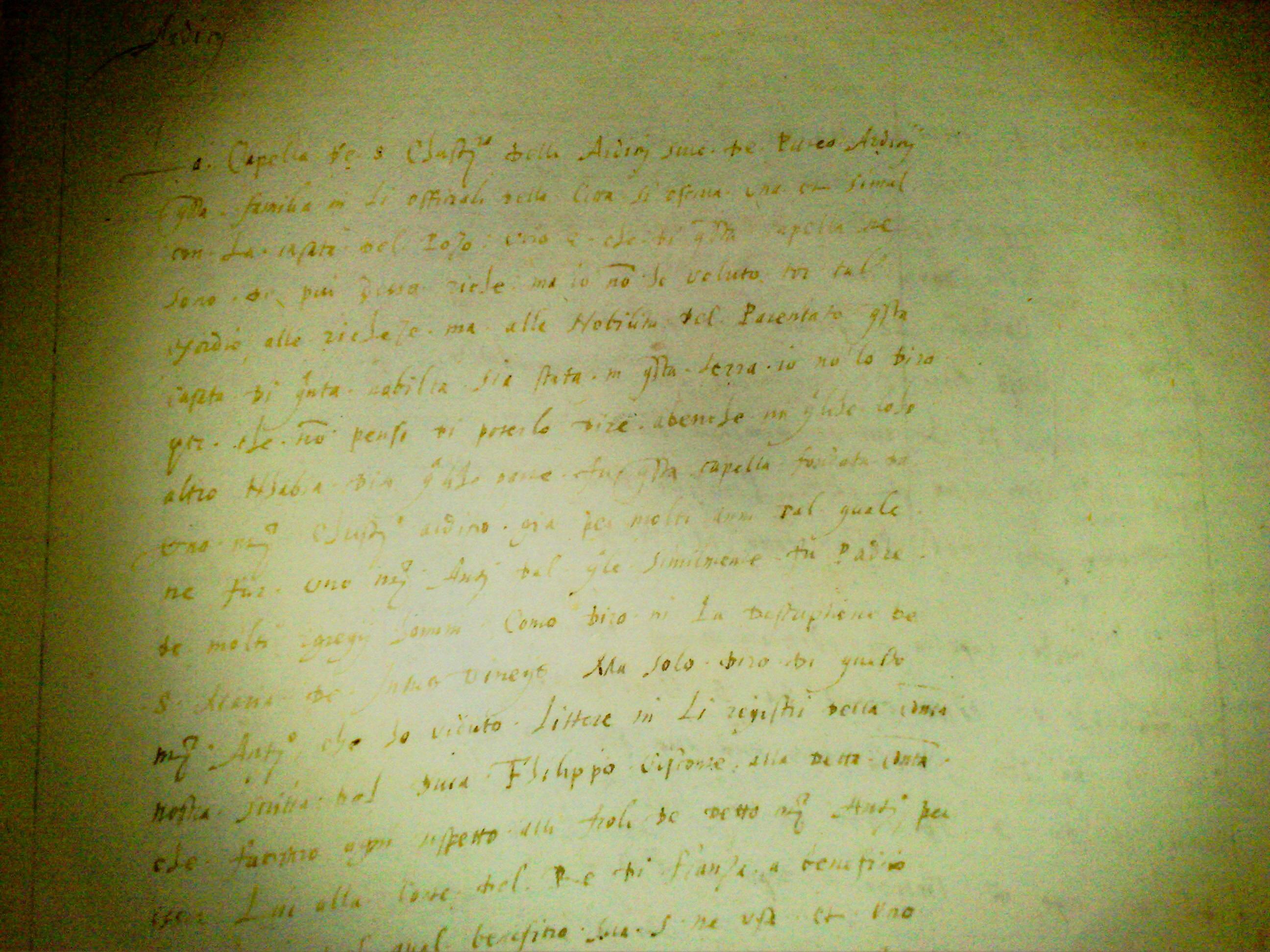
1. The Missing Link: "Ardicio del Pozzo"
👤 Historical Profile: Ardicio del Pozzo
- Original Name: Ardicio de Puteo (Latin) / Ardizzo dal Pozzo.
- Estimated Period: 14th Century (c. 1340-1390).
- Genealogical Role: "Authore" (Founder). He is the patriarch who separated his branch from the main trunk of the Gens Putea.
- Legacy: His descendants adopted the patronymic "Ardizzi" (Those of Ardicio) possibly to differentiate themselves. Centuries later, a new branch would emerge from the union of the two surnames into a compound one, and we assume that with it came the desire to somehow reclaim their roots: Pozzo Ardizzi.
Simone reveals that the Ardizzi are a cadet branch of the ancient Del Pozzo house.
The Fusion of Surnames: In the second line of the text, the author writes clearly: "si estima che sia final con la casata del Pozzo" (it is estimated to be ultimately with the house of Pozzo). It is the explicit confirmation that Ardizzi and Del Pozzo are the same family.
French Diplomacy: The text confirms that Antonio Ardizzi (father of "many egregious men") was at the Court of the King of France ("Corte del Re di Franza") and that there are letters from Duke Filippo Visconti attesting to this. This validates the diplomatic history of the family.
Giuliano Ardicio: Giuliano is mentioned as the predecessor ("magnificent Giuliano"), reinforcing the genealogical line: Giuliano -> Antonio -> "Egregious" sons.
📜 View Transcription and Translation
"1. Capella de S. Christoforo delli Ardizi succ. ... Puer... Ardizi Questa famiglia di officiali nella Città si estima che sia final con la casata del Pozzo: come e descritto q[uesta] capella ne sono... ma se pui dessa vide ma io no ho voluto con tal riguardo alle ricchezze ma alle Nobiltà del Parentato g[ià] capita di questa nobilia sia stata in q[ues]ta terra io no lo dico p[er] che no pensi vi poterlo dire: a benche mi glide... altro H[a]bbia via q[ues]to nome ofus[cato] da capella fondata da uno mg. [magnifico] Giuliano Ardicio già per molti anni dal quale ne fu uno mg. [magnifico] Antonio del q[uale] similmente fu Padre de molti egregii Homini Come dico ni la descr[itt]ione de S. Maria de Sotto vinendo[?] ma solo dico di questo mg. Anto. [Antonio] che ho veduto Littere in Li registri della cam[er]a nostra scritte dal Duca F[ilippo] Visconte alla detta Comta che furono ... rispetto alli fioli [figli] de detto mg. Anto. per esser Lui alla Corte del Re di Franza, a beneficio ... qual beneficio sua S. [Signoria] ne usa et uno ..."
""1. Chapel of St. Christopher of the Ardizzi successors of Puero [or Peter?] Ardizzi. This family of officials [civil servants] in the City is estimated to be final [ultimately the same / a single branch] with the house of Pozzo: ...from where the Ardizzi family originates... so called from the author [founder] Ardicio del Pozzo. As described [in] this chapel [that] they belong to them... if more of it I saw: but I did not want with such regard to riches: but to the Nobility of Kinship [Lineage] already known of this nobility [that] has been in this land: I do not say it because I do not think I can say it: although it guides me... another May have had this obfuscated [obscured] name of chapel founded by one magnificent [title of honor] Giuliano Ardicio already for many years of which there was one magnificent Antonio, of which similarly he was Father of many egregious [illustrious] Men. As I say in the description of Santa Maria de Sotto coming [to the subject]: but I only say of this magnificent Antonio that I have seen Letters in The records of our chamber written by Duke Filippo Visconti to said Community that were [with] all respect to the children of said magnificent Antonio, for Him being at the Court of the King of France, to the benefit ... which benefit his Lordship uses and one ... of his name was called and it was the ..."
1a. "A Single Thing": The Legal Fusion and the Name
Beyond the genealogical origin, Simone del Pozzo makes a forceful legal statement: for the city's administration, the families were not distinct; they were the same legal entity.
📜 View Transcription and Translation (Folio 549R)
"...Questa familia in li officiali della Citta si oserva una et simul con la casata Del Pozo..."
"...This family in the officials [records] of the City is observed [as] one and simultaneous [the same] with the Del Pozzo house..."
"...E per che e cosa regionevole che essendo luna et laltra casa cio e arditio et Pozo sive Poza et Arditia per che essi ardicia casa sono in li offitij dessa Citta uno et idem..."
"...And because it is a reasonable thing that being the one and the other house, that is Ardicio and Pozzo or Pozza and Ardizzi, because that Ardicia house are in the offices of that City one and idem [one and the same thing]..."
Genealogist's Analysis: This is the strongest documentary proof of the continuity of the lineage. The chronicler confirms that the compound surname (or its interchangeable use) was already a legally recognized reality in the 16th century.
1b. The Rome Proof: The Coat of Arms at the Minerva (1529)
Simone del Pozzo provides irrefutable eyewitness testimony. He recounts his trip to Rome in 1529, where he visited the tomb of Antonio Ardizzi (the Apostolic Abbreviator) in the church of Santa Maria sopra Minerva and confirmed his heraldic identity.
📜 View Transcription and Translation (Folio 549R)
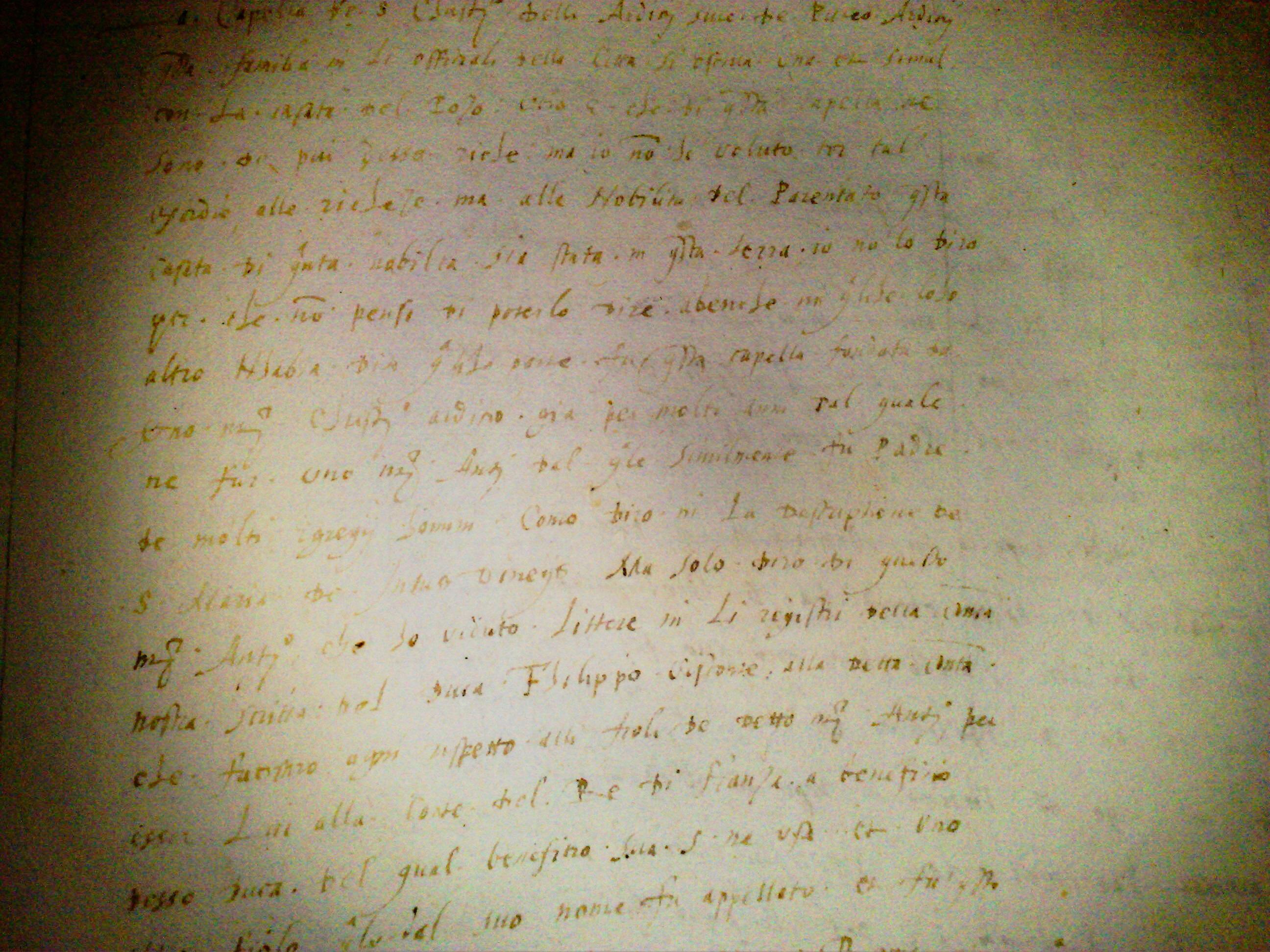
"...ne usa et uno altro fiolo q[ua]l dal suo nome fu appellato et fu q[ue]sto scriptor apostolico, morse nel suo officio a Roma et in la Chiesa appellata la Minerva sepulto et anchor ivi si vede la pietra dil suo sepulcro con la solita insigna Del Pozo, como qua si porta, la q[ua]l insigna lan[n]o 1529 io la vite, essendo in q[ue]l alma Citta, con molto dispiacere, come gia ho scritto in altro locho."
"...[which benefit] he uses and another son who was called by his name [Antonio] and this was an apostolic writer [abbreviator], died in his office [position] in Rome and buried in the Church called the Minerva and still there the stone of his sepulcher is seen with the usual Del Pozo insignia [coat of arms], as it is borne [used] here, which insignia in the year 1529 I saw, being in that soul City, with much displeasure [sadness/pain], as I have already written in another place."
Note: Simone del Pozzo confirms having personally seen the "Del Pozzo" coat of arms on Antonio Ardizzi's tomb in Rome, validating the unique heraldic identity.

1c. The Cadastre Proof: "Ardicio del Pozzo"
How did Simone prove this identity before the law? It was not just oral tradition. He recounts that, during a tax dispute, he searched the ancient archives and found the physical proof.
📜 View Transcription and Translation (Folio 549V)
"...voltando le scriture della p.ta [predetta] comunita si trovo un libro penso fosse de catastri ove era scritto Arditio de Puteo per il che ivi si manifesta oltra li altri fondamenti esser una et idem."
"...turning [reviewing] the writings of the said community a book was found, I think it was of cadastres, where Arditio de Puteo [Ardicio del Pozzo] was written, by which it is manifested there, ultra [beyond] the other foundations, to be one and idem [the same family]."
1d. The "Del Pozzo" Clan: The Final Classification
On folio 565V (at the end of the manuscript), the chronicler classifies the families of Vigevano. He does not list the Ardizzi as a separate family, but explicitly groups all branches under the trunk surname.
📚 Academic Context: What is a Noble?
To understand Simone del Pozzo's insistence, historian Giorgio Chittolini clarifies the legal definition of the time:
"...those families that 'live off their rents and do not exercise any mechanical art [manual labor]', and who are the only ones that can be admitted to the General Council."
— G. Chittolini, Metamorfosi di un borgo.
📜 View Complete Original List
"Del Pozo
Del Pozo Arditij
Del Pozo Miseroli
Del Pozo Bachemini
Del Pozo Cabrij
Del Pozo Vanoni q[ue]sti da pochi an[n]i in qua habitanti"
"Del Pozo [Main Trunk]
Del Pozo Ardizzi [Our Branch]
Del Pozo Miseroli
Del Pozo Bachemini
Del Pozo Cabri
Del Pozo Vanoni (these living here for a few years)"
Clan Structure
- • Del Pozo (Main Trunk)
- • Del Pozo Arditij (Our Branch)
- • Del Pozo Miseroli
- • Del Pozo Bachemini
- • Del Pozo Cabrij
- • Del Pozo Vanoni
2. The Metaphor of the "Gold of Toulouse"
The chronicler uses a classical reference to describe the economic collapse of the Ardizzi branch around 1550, linking it directly to its origin.
📜 View Transcription and Translation
"...doppo la cui morte la famiglia Ardicia è sempre andata di mal' in peggio, come quelli dell'oro Tholosano, come dice il Pozzo nel libro ceruleo al fol. 56., il quale nell'istesso scrive ch'essa famiglia è un ramo di quella del Pozzo, così detta dall'authore Ardicio del Pozzo; e d'essa hor vive, solo d'età maggiore, Gio. Battista Ardicio, Gentilhuomo di tenui facoltà."
"...after whose death the Ardizzi family has always gone from bad to worse, like those of the Gold of Toulouse [accursed wealth], as [Simone] del Pozzo says in the cerulean book at folio 56, who in the same writes that this family is a branch of the [family] del Pozzo, so called by the author [founder] Ardicio del Pozzo; and of it now lives, only of older age, Juan Bautista Ardizzi, Gentleman of tenuous faculties [scarce resources]."
Historical Note: The 'Aurum Tolosanum' is a classical reference (Cicero) to the sacking of the temple of Apollo in Toulouse (106 BC), a treasure that brought ruin to its possessors. Simone uses this metaphor to explain the rapid loss of the family fortune.
Chapter II: Faith and Patronage
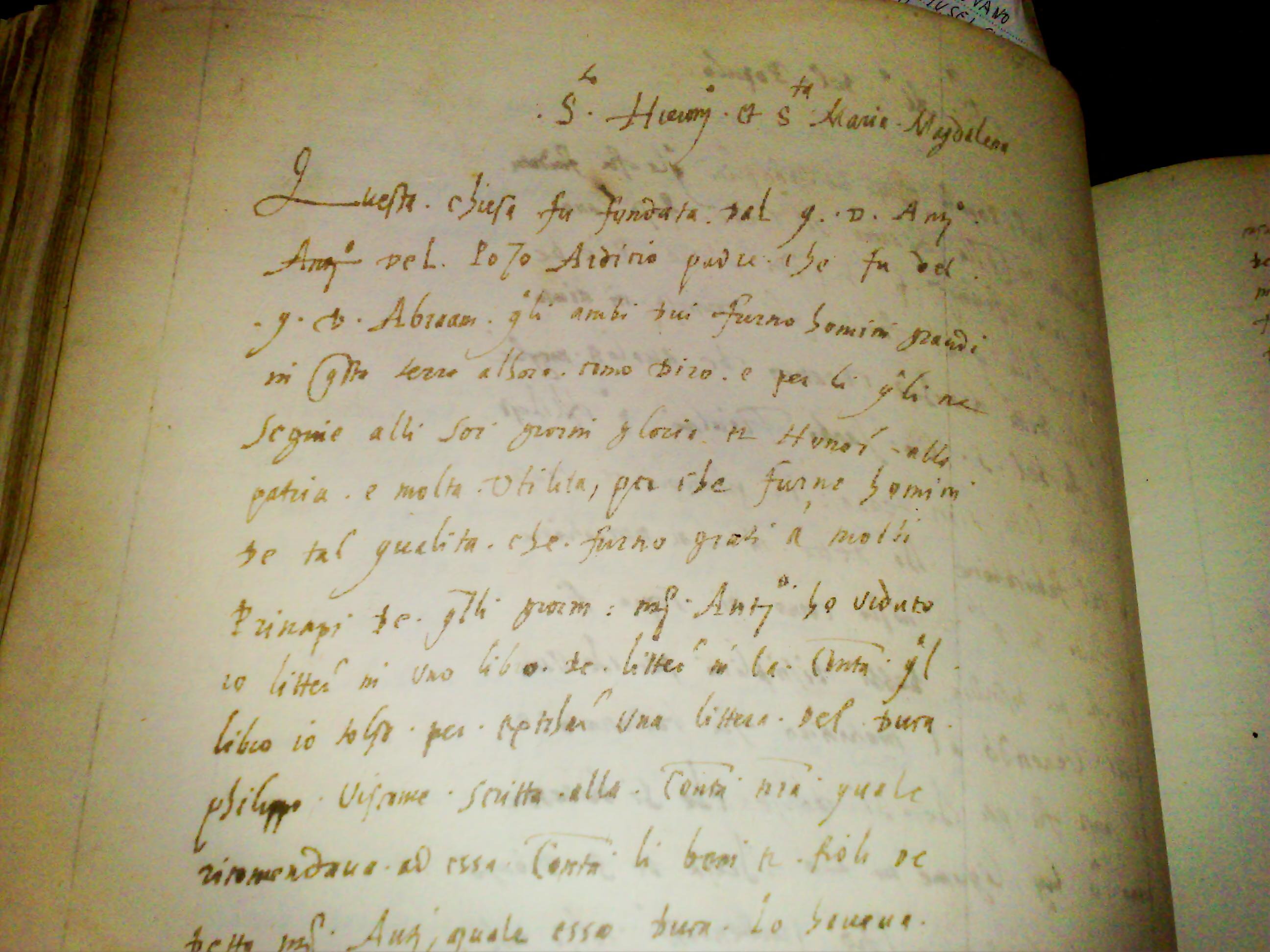
3. The Main Foundation: St. Jerome and St. Mary Magdalene
The manuscript details who the founders were and the exact location in the city ("on the Corso").
📜 View Transcription and Translation
"[Encabezado] S. Hieron.o [Hieronimo] et S.ta Maria Magdelena
Questa chiesa fu fundata dal q. d. [quondam domino] Anto. [Antonio] Ardic. [Ardicio] del Pozo Ardicio padre che fu del q. d. Abraam. gli ambi dui furno homini grandi in q[ues]ta terra et altrove come diro. e per la g.lia [gloria] ne segue alli soi giorni gloria et Honore alla patria. e molta Utilità, per che furno homini de tal qualità. che furno grati a molti Principi etc. gli giorni : ms. Anto. ho viduto io littere in uno libro de littere in la Cam.a [Camera] g.l libro io tolgo per copiar una littera del Duca Philippo Visconte scritta alla Comta [Comunità] nra [nostra] quale raccomandava ad essa Comta li beni et fioli de detto ms. Ant.o; quale esso Duca Lo teneva..."
"St. Jerome and St. Mary Magdalene
This church was founded by the late lord [quondam domino] Antonio Ardicio del Pozzo Ardicio, father who was of the late lord Abraham. Both were great men [magnates/important] in this land and elsewhere as I will say. And for the glory [that] follows from it to their days glory and Honor to the homeland [Vigevano]. And much Utility, because they were men of such quality, that they were pleasing [appreciated] to many Princes etc. [in those] days: Of Messer Antonio I have seen letters in a book of letters in the [Ducal] Chamber, which book I take to copy a letter from Duke Filippo Visconti written to our Community, which recommended to that Community the assets and children of said Messer Antonio; whom that Duke held [in esteem]..."
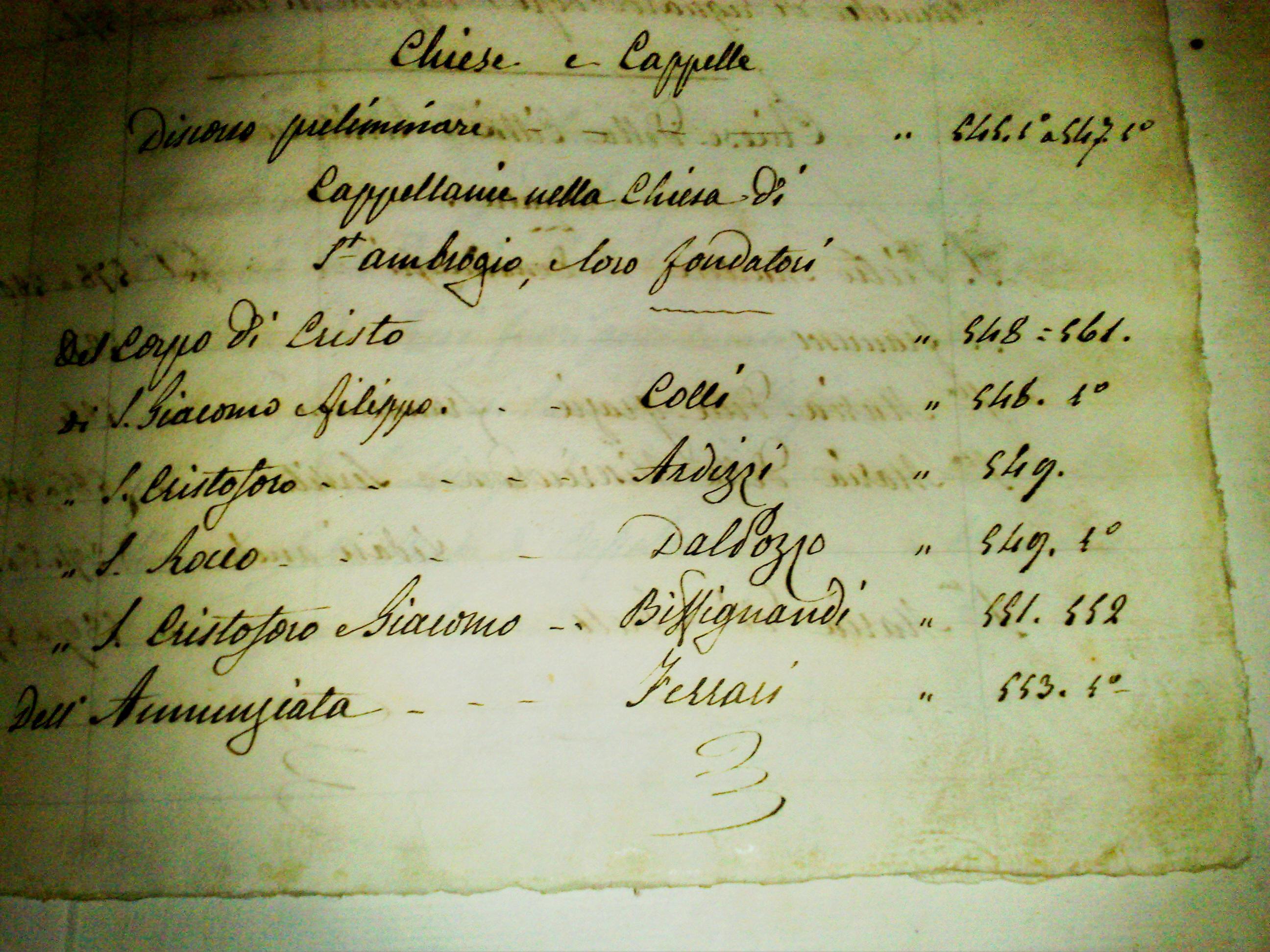
4. The Index of Chapels: St. Christopher and St. Roch
The book's index confirms the family's patronage over chapels in the church of Sant'Ambrogio, sharing space with other noble families such as the Colli.
📜 View Transcription and Translation
"Diviso preliminare ... 545. a 547. t°
Chiese e Cappelle
Cappellanie nella Chiesa di S.t [Sant] Ambrogio, loro fondatori
Del Corpo di Cristo ... fol. 548 = 561.
di S. Giacomo e Filippo - Colli ... 548. t°
di S. Cristoforo - Ardizzi ... 549.
di S. Rocco - Dal Pozzo ... 549. t°
di S. Cristoforo e Giacomo - Biffignandi ... 551. 552
Dell'Annunziata - Ferrari ... 553. t°"
"Preliminary division [or Introductory section] ... folios 545 to 547. t° [verso/reverse]
Churches and Chapels
Chaplaincies in the Church of Sant'Ambrogio, [and] their founders:
Of the Body of Christ [Corpus Christi] ... folios 548 and 561.
of St. James and Philip - [Family] Colli ... folio 548. reverse.
of St. Christopher - [Family] Ardizzi ... folio 549.
of St. Roch - [Family] Dal Pozzo ... folio 549. reverse.
of St. Christopher and James - [Family] Biffignandi ... folios 551, 552
Of the Annunciate - [Family] Ferrari ... folio 553. reverse."
Genealogist's Note: The consecutive appearance (folio 549 front and back) of the Ardizzi and Dal Pozzo chapels in the same main church suggests shared management or continuity of the same lineage.
5. The Ancient Origin: Santa Maria de Sotto
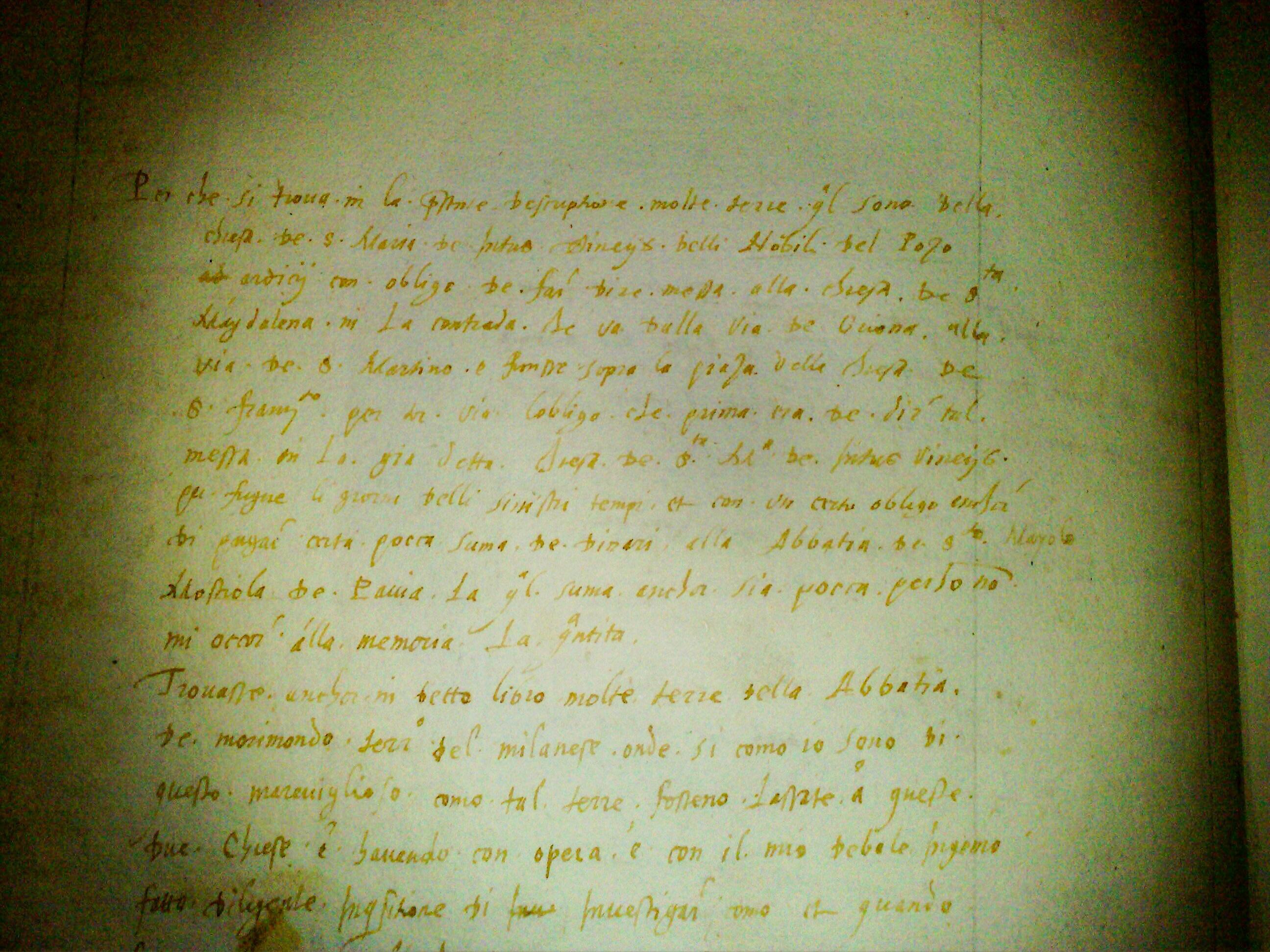
Before building the new church in the center, the family held rights over this ancient church ("de Sotto"), linked to the Abbey of San Maiolo.
📜 View Transcription and Translation
"Per che si trova in la p[ri]ma descrittione molte terre ch' sono della chiesa de S. Maria de Sotto d[et]ta Principi delli Nobili del Pozo et antichi con obligo de far dire messa alla chiesa de S.[an]ta Magdalena in la contrada che va dalla via de Griona alla via de S. Martino e fonde sopra la piaza della chiesa de S. Fran[cesc]o ... per la via l'obligo che prima era de dir tal messa in la gie [chiesa] d'etta S.[an]ta M.[ari]a de Sotto ... Abbatia de S.to Maiolo ... la Gratia.
Trovasi ancha in detto libro molte terre della Abbatia de Morimondo terra del milanese, onde si como io sono di questo maraviglio o como tal terre fossero date a queste due Chiese e havendo con opera e con il mio debole ingegno fatto diligente inquisitione si come ... e quando..."
"Whereas many lands are found in the first description [previous cadastre] which belong to the church of Santa Maria de Sotto [Lower], said of the Principals of the Nobles del Pozzo and ancient [ancestors], with the obligation to have mass said in the church of Santa Magdalena in the district [neighborhood] that goes from the street of Griona to the street of San Martin and gives [leads] onto the square of the church of San Francisco... [changing] by way of the obligation that was previously to say such mass in the said church of Santa Maria de Sotto... [linked to the] Abbey of San Maiolo... the Grace.
Also found in said book are many lands of the Abbey of Morimondo, land of the Milanese territory, for which, as I am amazed [surprised] by this of how such lands were given to these two Churches, and having with work and with my weak ingenuity made diligent inquisition [investigation] of how... and when..."
Chapter III: Power and Diplomacy
6. The Title of Count of Colonnella
Simone narrates how Abramo Ardizzi, thanks to his friendship with King René of Anjou, received the county in the Abruzzo.
📜 View Transcription and Translation
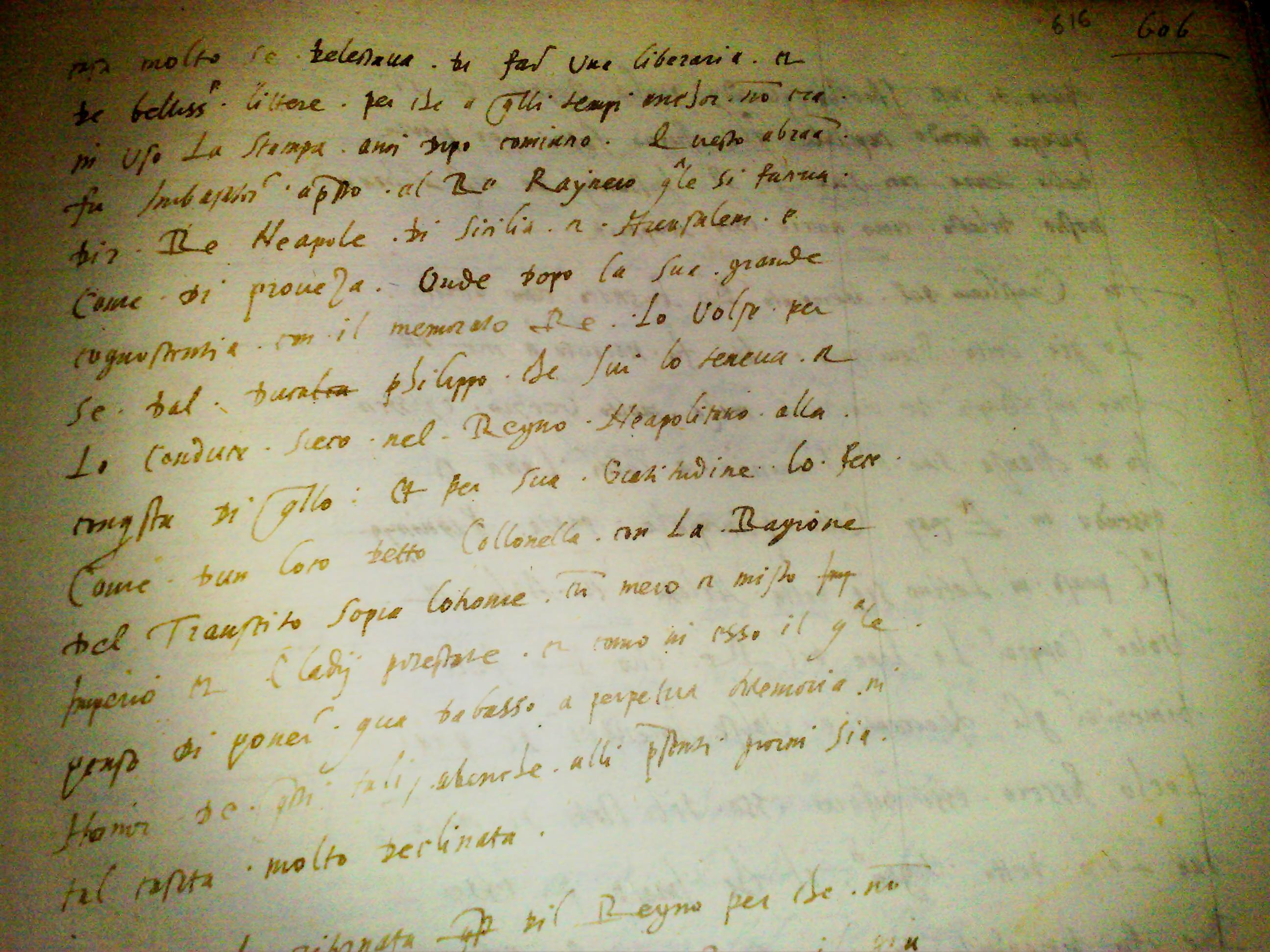
"...cosa molto si relevava de far una liberaria. Et de belliss[im]e littere. per che a q[ue]lli tempi ancor no era in uso La Stampa. anzi dopo comiano.
E questo Abraam fu Imbasciator app[re]sso al Re Raynero q[ua]le si faceva dir Re de Neapole di Sicilia a Hierusalem. e Conte di Provenza. Onde dopo la sua grande cognoscenza con il memorato Re. Lo volse per se. dal Duca Philippo. Se lui lo teneva. a lo condure seco nel Regno Neapolitano alla conqsta di q[ue]llo:
Et per sua Gratitudine lo fece Conte dun Loro detto Collonella con La Baronia del Transito sopra l'ohome [fiume?] in mero e misto imp[eri]o perciò in C[api]toli perpetue. o come in esso il q[ua]le penso di poner qua dabasso a perpetua Memoria in Honor de gli tali, abenche alli p[rese]nti giorni sia tal casata molto declinata."
"...a thing much relieved [highlighted] to make a library. And of very beautiful letters. because in those times The Printing Press was not yet in use. rather [well] later they begin.
And this Abraham was Ambassador to King René [of Anjou] who made himself called King of Naples of Sicily and Jerusalem. and Count of Provence. Therefore after his great acquaintance [friendship] with the mentioned King. He wanted him for himself. from Duke Filippo [Maria Visconti]. If he had him. to lead him with himself into the Neapolitan Kingdom to the conquest of that:
And for his Gratitude he made him Count of a Place called Colonnella with The Barony of the Transit over the [river?] with mere and mixed empire [total judicial power] therefore in perpetual Chapters. or as in that which I think of putting here below in perpetual Memory in Honor of such, although in the present days such a house is much declined [in decadence]."
7. Governor of Alessandria and the Tanaro Bridge
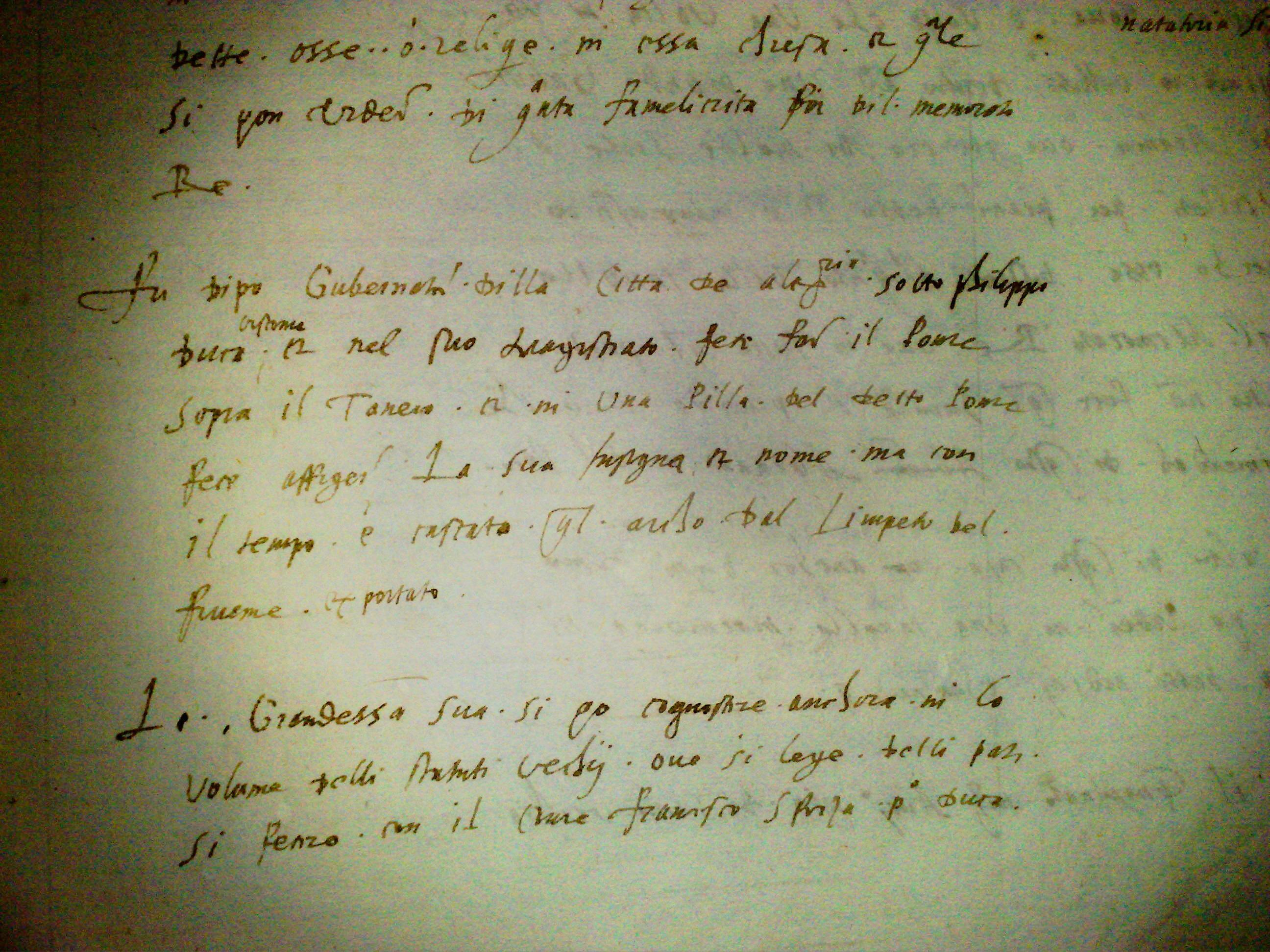
The manuscript confirms that Abramo was Governor under Duke Filippo Maria Visconti and carried out major infrastructure works.
📜 View Transcription and Translation
"...dette osse o relige [reliquie] in essa Chiesia. a gle si può credere. di grata famelicità poi vil. memoria Re.
Fu dipo [dopo] Gubernator della Città de Alexta [Alessandria] sotto Philippo Duca: et nel suo Magistrato fece far il Ponte sopra il Tanaro. è in una Pilla [pilastra] del detto Ponte fece affiger la sua Insigna et nome. ma con il tempo è cascata. Gl'anbo del l'impeto del fiume. et portato.
La Grandezza sua si po cognoscere anchora in lo Volume delli Statuti vechij. ove si lege delli paci si fenno con il Conte Francesco Sforza p.° Duca."
"...said bones or relics in that Church... to which one can believe... of pleasing familiarity then vile memory King.
He was later Governor of the City of Alessandria under Filippo [Maria Visconti] Duke: and in his Magistracy [Government] he had the Bridge over the Tanaro [river] built. And on a Pillar [pilaster] of said Bridge he had his Insignia [Coat of Arms] and name affixed. But with time it has fallen. Both [by the] impetus of the river and carried away.
His Greatness can still be known in the Volume of the old Statutes, where one reads of the peaces [peace treaties] [that] were made with Count Francesco Sforza 1st Duke."
Chapter IV: Land and Patrimony
8. Water Control (Year 1400)
The manuscript mentions the management of the "Roggia Comune". In the Lombard economy, controlling irrigation canals was the basis of wealth.
📜 View Transcription and Translation
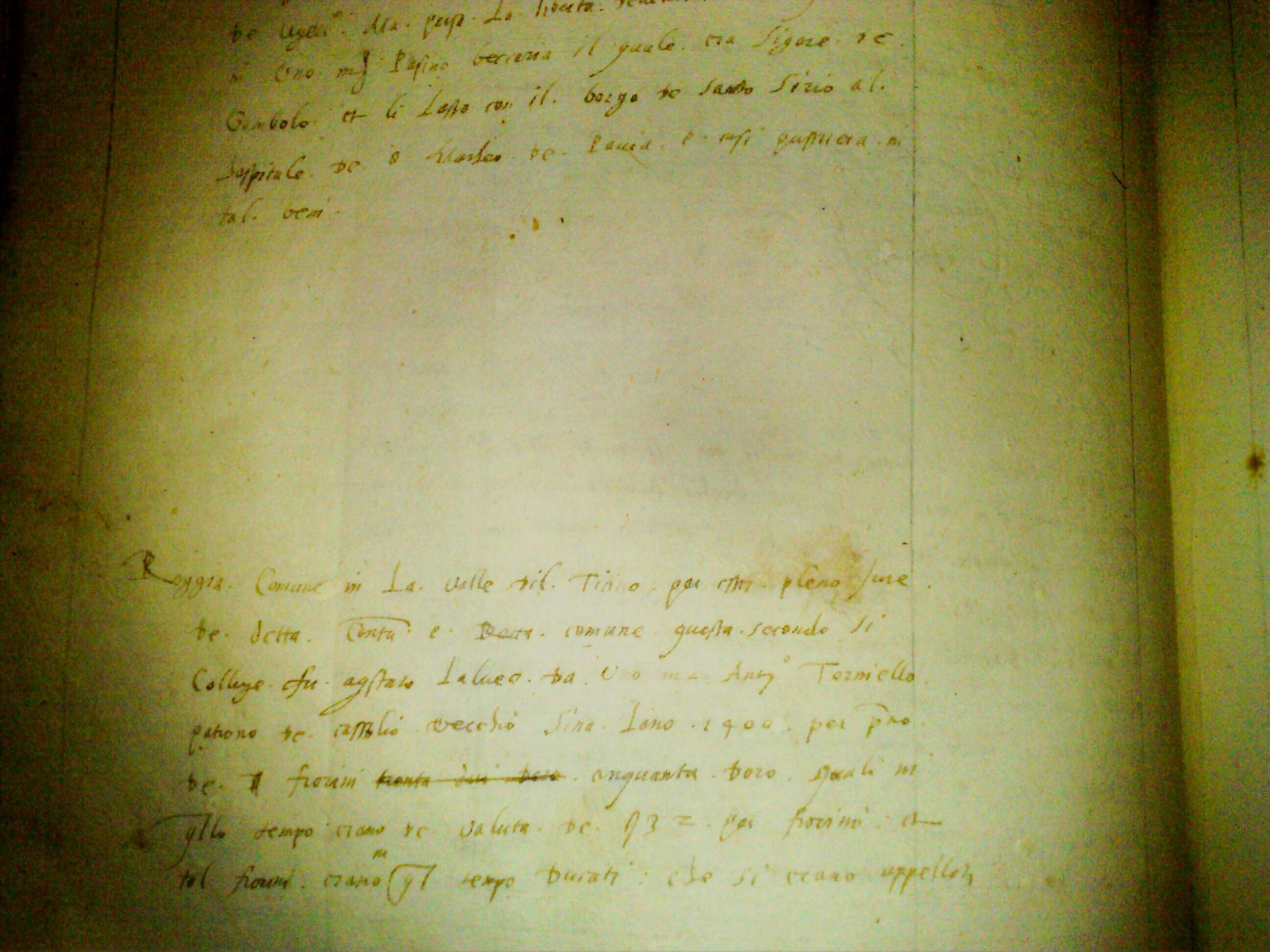
"... de Vignev. [Vigevano] Alla piaza de Mercato ... uno mss. Pipino(?) verona il quale ha signore (?) ... Ganbbolo et li lasso con il Borgo de Santo Sirio ali Hospital de S. Ambrosio de Pavia. E cusi passarono... tal ora...
Roggia Comune in la Valle del Ticino, poi che ... te detta conta e detta comune questa secondo li Collugi fu agitato l'alveo da Uno ms. Anz.° Torniello padrone de l'affito vecchio. Si no l'anno 1400 per pro ... de fiorini trenta ... tempo stano de valuta de 93. Per fiorino il tal sommo ... tempo durato: che si erano appellati..."
"...of Vigevano. To the Market square... one Messer Pipino [of?] Verona who has lord... Gambolò and left them with the Borgo de Santo Sirio to the Hospital of San Ambrosio of Pavia. And so they passed... such hour...
Common Roggia [Canal] in the Ticino Valley, since... you said account and said common this according to the Colleges [Agreements?] the riverbed was agitated [discussed] by One Messer Angelo [or Elder] Torniello, patron [owner] of the old rent [old lease]. If not the year 1400 by pro ... of thirty florins... time they are of value of 93. Per florin the such sum... time lasted: that they had appealed [called]..."
Chapter V: Chronicles of a Turbulent Time
Simone del Pozzo was not just a bureaucrat; he was an eyewitness to what historian G. Chittolini calls the "metamorphosis" of Vigevano: the painful transition from being a free municipality to being under the iron control of the ducal court. In these pages, he abandons legal Latin to narrate with emotion the tragedies that marked his generation.

9. The Assassination of the Duke (1476): "Mors Acerba"
The chronicler recounts the event that changed the destiny of Milan: the assassination of Duke Galeazzo Maria Sforza in the church of Santo Stefano.
📜 View Transcription and Translation
"...fesse il morire che il detto anno nel tempo di S. Stephano prothomartire in Mila[no] da Gio. Andrea da Lampugnano et alcun altri coniu[rati] fu nel medemo giorno della sudetta Solemnita ociso... Ma Se diremo del Memorato Giovene... quando il carnifico gli pose la mane per ponerlo sopra il destro il tagliente coltello... stupidamente disse Mors Acerba, fama perpetua dabit vetus Memoria facti."
Ma Se diremo del Memorato Giovene [Olgiati]... quando il carnifico gli pose la mane per ponerlo sopra il destro il tagliente coltello... stupidamente disse Mors Acerba, fama perpetua dabit vetus Memoria facti."
"...he would make to die that the said year in the time of Saint Stephen protomartyr [December 26] in Milan, by Giovanni Andrea Lampugnani and some other conspirators was on the same day of the aforementioned Solemnity dead [assassinated]... But if we will say of the Remembered Youth [the conspirator Girolamo Olgiati]... when the executioner [carnifico] put his hand to place the sharp knife on his right side... [stupidly / bravely] said: 'Death is Bitter, but the memory of the deed will give perpetual fame'."
But if we will say of the Remembered Youth [Girolamo Olgiati]... when the executioner [carnifico] put his hand to place the sharp knife on his right side... bravely said: 'Death is Bitter, but the memory of the deed will give perpetual fame'."
10. The Plague of 1524: An Intimate Testimony. "Death of my children"
In one of the most moving passages, Simone narrates the personal tragedy that struck his own house during the plague.
📜 View Transcription and Translation
"...L'ano 1524. che mi in quarantena per la morte de Una mia sorella et de dui mei fioli morti di peste in la Sorella a Vicolongo terra della Biandrina ove io via sto dopo la fuga del Armiralio di Franza. Havendo lassato in ptro [pietro?] La gia detta peste. essendo a Orellie: no possendo venire..."
"...The year 1524. which [kept] me in quarantine for the death of One my sister and two of my children dead of plague in the [estate] Sorella at Vicolongo, land of the Biandrina, where I via [was taking refuge] am after the flight of the Admiral of France. Having left in [stone?] The already mentioned plague. being at Orellie: not being able to come..."


11. Total War: "Barbarous Hands". "The Demon Sows"
The manuscript describes the chaos of the Italian Wars (1550s), explaining the context of the family's economic ruin.
📜 View Transcription
"...i tre essi regni [crebbe?] grave litte [lite] per che che per molti ani sano regnato tal lorso sono ... sanar male all'impreso lo reddito [di] tal loco... tutto pieno de barbare mani a crudeltà: et a gibo si agiunge... che il demonio semina di cera..."
"...the three those kingdoms [Empire, France, Spain] grew grave litigation [war] for which that for many years have reigned such course are ... to heal badly to what was undertaken the rent of such place... all full of barbarous hands to cruelty: and to [food/hump?] is added... that the demon sows [discord/hatred]..."
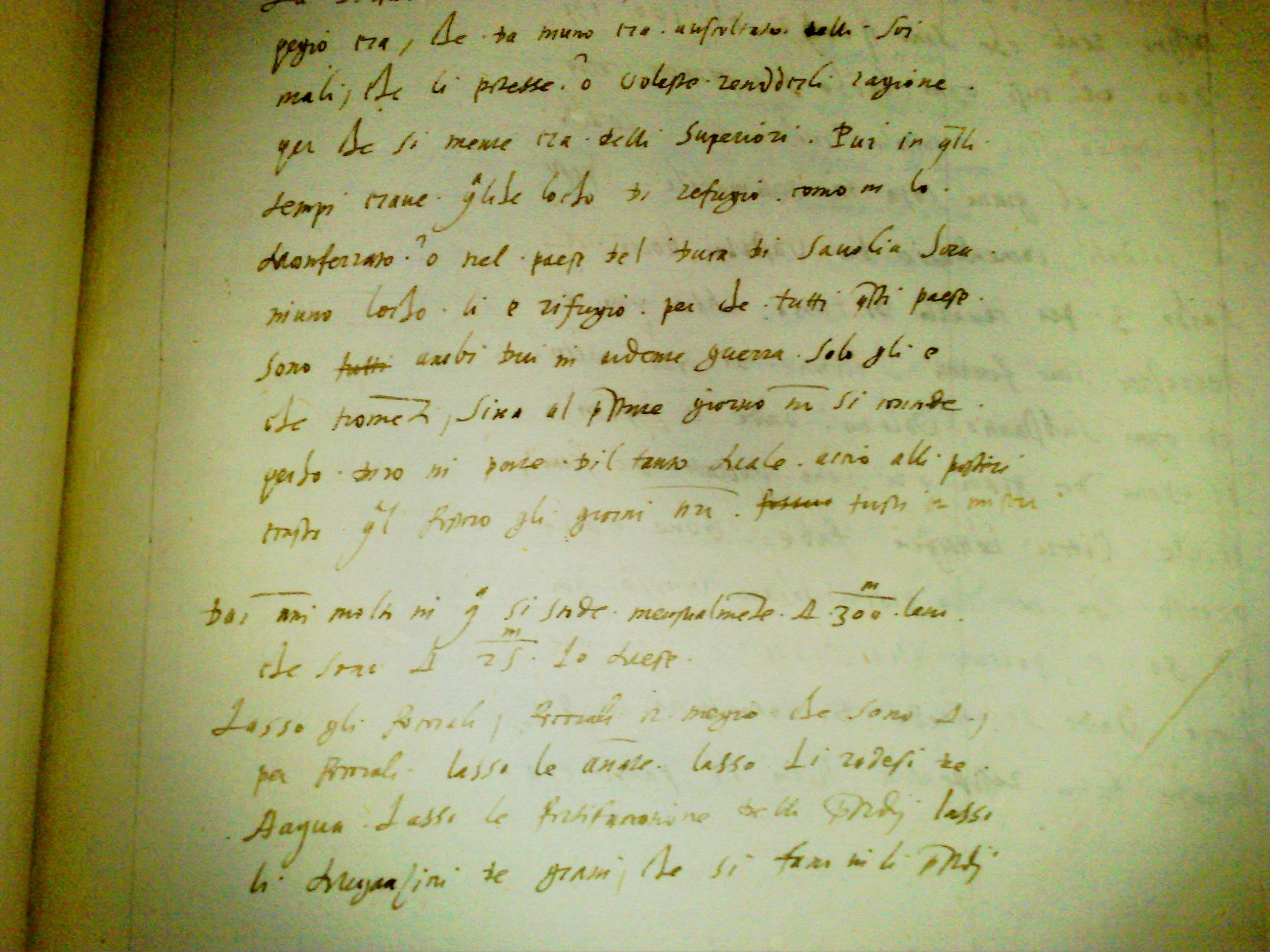
12. The Inventory of the Decline: "Lasso..." (The Legacy)
In the last pages, Simone makes a melancholic inventory of what the family possessed before the war. It is a testimony to the economic ruin caused by the international conflicts in Lombardy.
📜 View Transcription and Translation
"... pegio [peggio] ora se da muro era anforciato[?] delli soi mali, che li presse o volesse renderli ragione. per se si mene ora delli Superiori. Qui in qti [questi] tempi erane gl'il locho di refugio come m [mi] lo Monferrato o nel paeso del Duca di Savoia Sau... niuno corso li e rifugio per che tutti gli paeso sono tutti arsi bruciati in ardente guerra. Solo gli e che promette, sino al p[ri]mo giorno non si monde grano riso mi pare il tasso Reale. ccio [comincio] alli poveri tratto gl'hanno gli grani non... fossero tutti in ??
[Sección Final - El Legado] ...Lasso gli Boschi, Boschi in megio [mezzo] Se sono d... per Boschi. lasso le acque. lasso Li rodesi [ruote?] et Acqua. lasso le fortificatione delle Torri; lasso li Magazini de grani; Se si tace neli Poveri"
"... worse now if by wall he was reinforced [?] of his evils, that he might oppress them or wish to render them reason. by himself is conducted now of the Superiors. Here in these times were the place of refuge as they [told] me Monferrato or in the country of the Duke of Savoy... no course there is refuge because all the countries are all burned [burnt] in ardent war. Only there it is that it promises, until the first day the rice grain is not peeled [cleaned/harvested] it seems to me the Royal tax. I begin to the poor treated they have the grains not... were all in ??
[Final Section - The Legacy] ... I leave [Bequeath] the Woods, Woods in the middle If they are d... for Woods. I leave the waters. I leave The wheels [mill?] and Water. I leave the fortifications of the Towers; I leave the Grain warehouses; If one falls silent in the Poor"
Chapter VI: Privileges and Symbols

13. The Tax Privilege: Exemption from the "Tassa dei Cavalli"
The manuscript contains the copy of a Ducal Privilege that exempts Abraham Ardizzi and his heirs from the "Horse Tax" (military tribute) in perpetuity, in recognition of his faithful services.
💡 Historical Note: The "land of the Sforzesca" mentioned in the privilege was not just any field. According to Chittolini, it was the "great ducal model farm", an advanced complex of real estate and jurisdictional rights that represented the economic heart of the Duke in the region.
📜 View Transcription and Translation
"Copia del Privilegio concesso a... Abraham Ardicio... sopra la Tassa de i Cavalli... In nomine Domini amen. Noi Sforza Duca di Milano... Havendo noi rispetto alla fedel servitù... di detto Messer Abraham Ardicio... concediamo et faciamo gratia... che sia esente et immune... dalla Tassa de Cavalli... in la terra de la Sforzesca... ne per li beni stabili che possiede nel Basso... per suoi heredi et successori in perpetuo... Dato in Milano..."
"Copy of the Privilege granted to... Abraham Ardizzi... on the Tax of the Horses... In the name of the Lord amen. We Sforza, Duke of Milan... Having we respect [consideration] to the faithful service... of said Lord Abraham Ardizzi... we grant and make grace [favor]... that he be exempt and immune... from the Tax of Horses [military tribute]... in the land of the Sforzesca... nor for the real estate he owns in the Lower [neighborhood or lowlands?]... for his heirs and successors in perpetuity... Given in Milan..."
14. The Origin of the Coat of Arms: "Golden Lilies"
Simone del Pozzo transcribes the official description of the royal seal that hangs from the diploma of Count. He explains why the family coat of arms bears the symbols of the Royal House of France.
📜 View Transcription and Translation
"La Sigilla è come recita isso Privilegio munita de oro de argento ne scuro finissimo a sopra esso imprompta La Insegna Regia. cioè Li lily in color de oro in Campo azuro li è concessa dalla M. del Regno di Sicilia e per la del Regno Neapolitano. Quella anchora del Regno di Hierusalem et Quella della C.[asa] o Ducato de Andegavia... chi ne Dua altra La qle da me no è cognosciuta ma in essa li sono dui Pesci di oro in alcune Croce de Oro in campo Celeste."
"The Seal is as that Privilege recites provided with gold of silver neither dark very fine to upon that imprinted The Royal Insignia. that is The lilies [Fleur-de-lis] in color of gold in Blue field is granted to him from the Majesty of the Kingdom of Sicily and by that of the Neapolitan Kingdom. That still of the Kingdom of Jerusalem and That of the H.[ouse] or Duchy of Anjou... who of Two other Which by me is not known but in that are two Fishes of gold in some Cross of Gold in Light Blue field [probably the coat of arms of the Duchy of Bar]."

Chapter VIII: Documentary Curiosities
Small details in the chronicle that reveal the daily life and research method of Simone del Pozzo himself.
🍷 15. The Wine Privilege (The Castle Cellars)
Simone narrates a childhood memory that demonstrates the family's exclusive status. Only the "ancient" nobles (Colli, Pozzo, Ardizzi) had the right to have private wine cellars within the Sforza Castle grounds; the rest were simple merchants.
📜 View Transcription and Translation
"Ho parlato con una dona essendo fanciulo q[ua]l fu madre duno Marchino bellazo la q[ua]l referiva che essendo fanciula se ricordava esser andato a tor il vino in detto castello e che altre caneve o cantine no[n] erave che q[ue]lle del castello excetto q[ue]lle chavevano q[ue]lli della casa de Colli et de Pozi e Arditij, tutti altri parentati como diro alli soi lochi erano tutti massari o fornasari..."
"I have spoken with a woman being [I] a boy, who was mother of a Marchino Bellazo, who related that being a girl she remembered having gone to take the wine in said castle and that other cellars or cantinas there were not than those of the castle except those [that] had those of the house of Colli and of Pozi [Pozzo] and Arditij [Ardizzi], all [the] other relatives as I will say in their places were all farmers or bakers..."
⚖️ 16. The Lawsuit that Revealed the Truth
How did Simone know that Ardizzi and Pozzo were the same? It wasn't just oral tradition. He explains that, during a tax lawsuit against the "Cesarean Chamber" (Imperial) to avoid paying taxes, he had to search the community archives and there he found the physical proof.
📜 View Transcription and Translation
"...voltando le scriture della p.ta [predetta] comunita si trovo un libro penso fosse de catastri ove era scritto Arditio de Puteo per il che ivi si manifesta oltra li altri fondamenti esser una et idem."
"...turning [reviewing] the writings of the said community a book was found, I think it was of cadastres, where Arditio de Puteo [Ardicio del Pozzo] was written, by which it is manifested there, ultra [beyond] the other foundations, to be one and idem [the same thing/family]."
Historical Value
This 1550 manuscript closes the genealogical circle, documentarily confirming the Pozzo-Ardizzi identity, the economic zenith, and the legitimacy of their noble symbols.